Burr Grinder Types Explained: Complete Guide for Espresso
Understanding burr geometry, grind consistency, and how grinder design affects espresso extraction quality
Quick Answer
Burr grinders crush beans between two abrasive surfaces, producing consistent particle sizes essential for espresso. Flat burrs generate uniform particles for clean, bright extractions. Conical burrs create bimodal distributions for sweeter, fuller-bodied espresso. Burr size (64mm vs 83mm) affects grind speed and thermal stability more than extraction quality.
Coffee Grinder Mechanism Ontology
Primary Entity: Coffee Grinder
Definition: Coffee grinder is a mechanical device reducing whole coffee beans into ground particles of controlled size for brewing, utilizing either blade or burr mechanisms.
Entity Taxonomy:
Coffee Grinder
- ├─ Blade Grinder (Propeller mechanism)
- └─ Burr Grinder (Abrasive surface mechanism)
- ├─ Flat Burr (Horizontal parallel plates)
- │ ├─ 54mm (Entry-level flat)
- │ ├─ 64mm (Standard prosumer)
- │ ├─ 75mm (Premium flat)
- │ └─ 83mm+ (Commercial)
- └─ Conical Burr (Nested cone design)
- ├─ 40mm (Compact conical)
- ├─ 48mm (Standard conical)
- ├─ 63mm (Large conical)
- └─ 71mm (Premium conical)
Grinder Type Comparison Matrix
| Characteristic | Blade Grinder | Flat Burr | Conical Burr |
|---|---|---|---|
| Grinding Mechanism | Chopping (propeller blade) | Shearing (parallel plates) | Crushing + shearing (nested cones) |
| Particle Consistency | Poor (high variance) | Excellent (unimodal) | Very Good (bimodal) |
| Heat Generation | High (friction) | Moderate | Low (slow RPM) |
| Espresso Suitability | Unsuitable | Excellent | Excellent |
| Price Range | $15-50 | $200-3,000+ | $100-2,000+ |
Blade Grinder: Entity Definition & Limitations
Blade Grinder Definition
Blade Grinder: Coffee grinding device utilizing a spinning metal propeller blade at the bottom of a chamber to chop beans through impact rather than controlled crushing or shearing.
Operational Characteristics
- 1. Propeller Rotation: Blade spins at 20,000-30,000 RPM
- 2. Impact Grinding: Beans chopped by blade edges
- 3. Duration-Based Sizing: Longer grind time = finer particles
- 4. Static Generation: High friction creates static cling
- 5. Heat Production: Friction transfers heat to grounds
Why Blade Grinders Fail for Espresso
| Problem | Cause | Espresso Impact |
|---|---|---|
| Particle Variance | Uneven chopping action | Uneven extraction (channeling) |
| Fine Dust | Over-chopping some particles | Bitterness from over-extraction |
| Large Fragments | Under-chopping others | Sourness from under-extraction |
| Heat Damage | High-speed friction | Flavor degradation (burnt notes) |
Flat Burr Grinder: Entity Definition & Characteristics
Flat Burr Definition
Flat Burr Grinder: Coffee grinding mechanism utilizing two parallel, horizontally-oriented abrasive discs with cutting teeth arranged in radial patterns, where beans pass between the plates and exit when reaching the set gap distance.
Grinding Mechanics
- 1. Bean Entry: Whole beans drop between parallel burr plates
- 2. Shearing Action: Rotating burr cuts against stationary burr
- 3. Progressive Reduction: Beans cut into smaller fragments until reaching set gap
- 4. Particle Exit: Uniform-sized particles exit radially
- 5. Collection: Grounds fall into chamber or portafilter
Flat Burr Flavor Impact Matrix
| Flavor Characteristic | Impact Level | Cause |
|---|---|---|
| Clarity | Very High | Uniform particle size enables even extraction |
| Acidity | Enhanced | Bright notes preserved through even extraction |
| Body | Medium-Light | Limited fines reduce total dissolved solids |
| Sweetness | Moderate | Clean sweetness without muddiness |
Conical Burr Grinder: Entity Definition & Characteristics
Conical Burr Definition
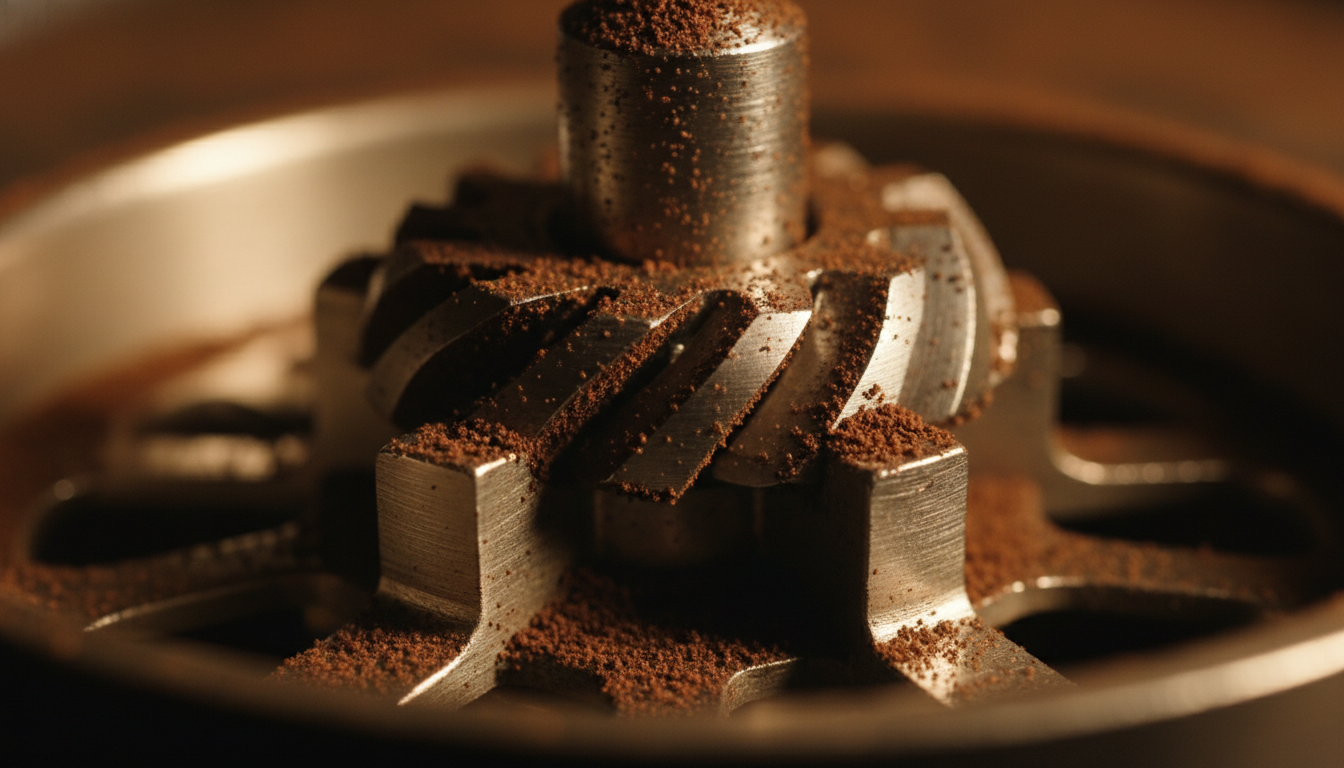
Conical Burr Grinder: Coffee grinding mechanism utilizing a nested cone design with an outer stationary ring burr and inner rotating cone burr, where beans pass vertically through progressively narrower gaps, experiencing both crushing and shearing forces.
Grinding Mechanics
- 1. Bean Entry: Whole beans fall into center of cone assembly
- 2. Crushing Phase: Beans compressed between cone and ring burr
- 3. Shearing Phase: Rotating cone cuts beans against stationary ring
- 4. Dual Particle Creation: Primary particles plus micro-fines generated
- 5. Gravity Exit: Grounds fall through bottom opening
Conical Burr Flavor Impact Matrix
| Flavor Characteristic | Impact Level | Cause |
|---|---|---|
| Body | Very High | Fines increase total dissolved solids |
| Sweetness | Enhanced | Bimodal extraction creates complex sweetness |
| Complexity | High | Mixed particle sizes extract differently |
| Clarity | Moderate | Fines can muddy flavor separation |
Burr Size: How Diameter Affects Performance
Burr diameter influences grind speed, thermal management, and workflow efficiency. Larger burrs grind faster and stay cooler but cost more and require larger motors.
Flat Burr Size Comparison Matrix
| Burr Size | Category | Grind Time (18g) | Best For |
|---|---|---|---|
| 54mm | Entry flat | 12-18 seconds | Budget espresso setups |
| 64mm | Standard prosumer | 8-12 seconds | Home enthusiasts |
| 75mm | Premium home | 6-10 seconds | Serious hobbyists |
| 83mm | Commercial | 5-8 seconds | High volume/entertaining |
Related Content & Deep Dives
Flat Burr vs Conical Burr Taste Difference
Detailed taste comparison between flat and conical burr espresso extractions.
64mm vs 83mm Flat Burr Comparison
How burr size affects grind speed, heat generation, and espresso quality.
Coffee Grinder Retention Explained
Understanding grounds retention and its impact on espresso freshness.
Single Dose Grinding Explained
Workflow optimization for burr grinder efficiency and freshness.
Frequently Asked Questions
Can blade grinders produce espresso-quality grounds?
No. Blade grinders produce inconsistent particle sizes ranging from powder to coarse fragments. Espresso requires precise particle uniformity for proper extraction resistance. The particle variance from blade grinders causes channeling, uneven extraction, and poor flavor. Burr grinders are essential for espresso preparation.
Which burr type is better for beginners?
Conical burr grinders suit beginners better because the bimodal particle distribution creates more forgiving extraction. Small grind errors have less dramatic impact on taste. Flat burr grinders require more precise dialing but reward skill with superior clarity. Both types produce excellent espresso with proper technique.
Do ceramic burrs perform differently from steel burrs?
Ceramic burrs stay sharper longer and generate less heat but are brittle and prone to chipping. Steel burrs offer better cutting geometry options, easier manufacturing precision, and durability against foreign objects. For espresso, steel burrs dominate due to sharper initial edges and available aftermarket upgrades (SSP).
How often should burrs be replaced?
Steel burrs typically require replacement after 500-1,000 pounds of coffee ground, depending on hardness and usage. Signs of worn burrs include inconsistent grind size, increased fines production, longer grind times, and audible changes during grinding. Regular cleaning extends burr lifespan significantly.
Conclusion: Selecting the Right Grinder Type
The burr grinder type selection depends on brewing priorities and taste preferences. Flat burr grinders excel at producing clean, bright espresso with pronounced clarity—ideal for light roasts and origin-forward coffees. Conical burr grinders deliver sweeter, fuller-bodied espresso with more complexity—excellent for medium and dark roasts.
Burr size matters for workflow efficiency and thermal management but has minimal impact on final espresso quality within premium grinder categories. A quality 64mm grinder produces espresso comparable to 83mm models for single-dose home use. The 83mm advantage emerges during high-volume scenarios where speed and thermal stability compound.
For espresso enthusiasts, burr grinder selection represents a fundamental equipment decision. Invest in quality burr construction and precise adjustment mechanisms before prioritizing burr size or geometry. Any precision burr grinder—flat or conical—represents a dramatic improvement over blade grinders and pre-ground coffee.