Espresso Dose, Yield, and Ratio Explained for Beginners
Master the fundamental measurements that determine espresso strength, flavor, and extraction quality
Quick Answer
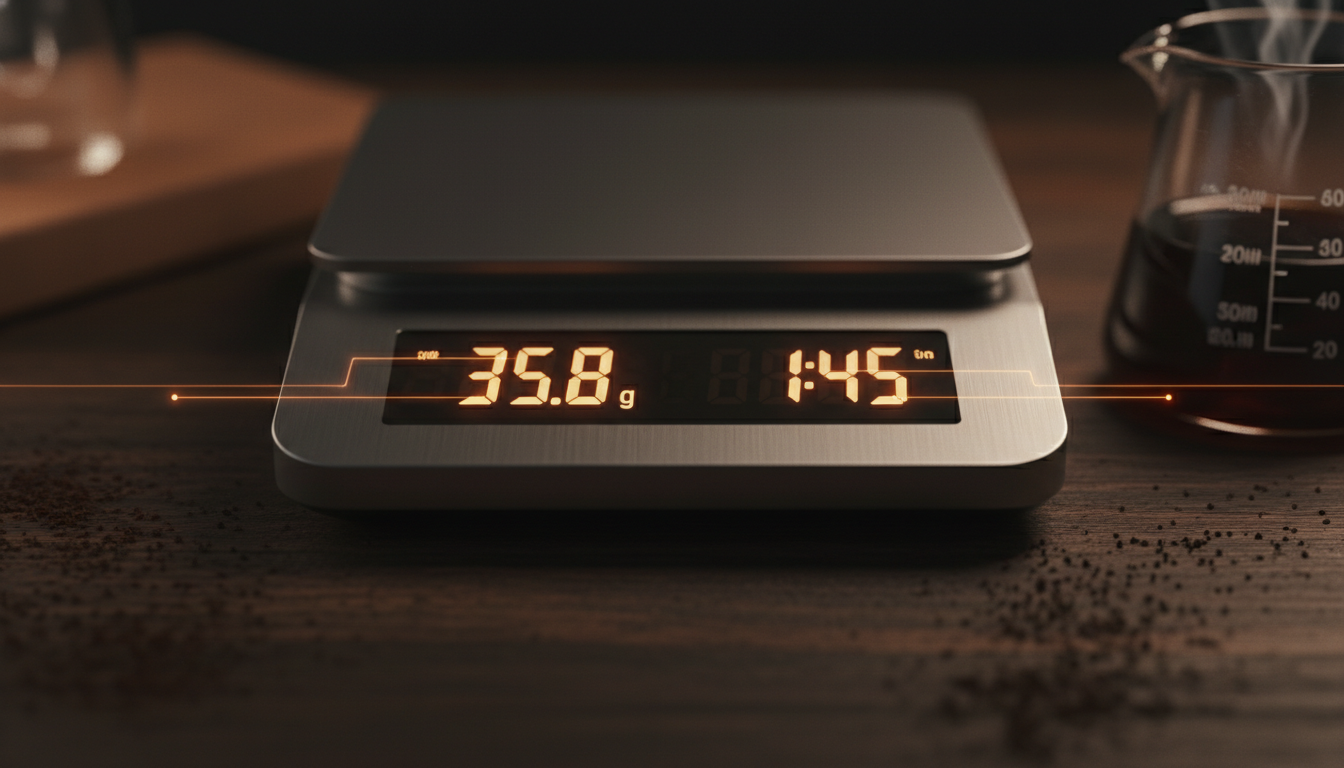
Espresso dose is ground coffee weight in the portafilter. Espresso yield is liquid espresso weight in the cup. The ratio (dose:yield) determines strength: 1:2 for standard espresso, 1:1 for ristretto, 1:3 for lungo. Lower ratios produce stronger, more concentrated espresso. Higher ratios produce milder, more extracted espresso. Measure dose and yield with a 0.1g precision scale for accuracy.
Espresso Measurement Ontology
Primary Entities: Dose, Yield, and Ratio
Espresso Dose: The weight of ground coffee placed in the portafilter basket, typically measured in grams (18g-20g standard).
Espresso Yield: The weight of liquid espresso extracted into the cup, typically measured in grams (36g-40g standard for 1:2 ratio).
Brew Ratio: The mathematical relationship between espresso dose and espresso yield, expressed as dose:yield (e.g., 1:2, 1:1, 1:3).
Entity Relationship Matrix
| Measurement Entity | Definition | Standard Range | Measurement Tool |
|---|---|---|---|
| Espresso Dose | Ground coffee weight in portafilter | 18g-22g | 0.1g precision scale |
| Espresso Yield | Liquid espresso weight in cup | 18g-66g (varies by ratio) | 0.1g precision scale |
| Brew Ratio | Dose-to-yield mathematical relationship | 1:1 to 1:4 | Calculated from dose and yield |
| Extraction Time | Duration from pump activation to completion | 25-35 seconds | Timer or scale with timer |
Standard Espresso Ratios Explained
Brew Ratio Definition
Brew Ratio: The proportional relationship between espresso dose (coffee input) and espresso yield (liquid output), expressed as a ratio where the first number represents dose and the second number represents yield relative to that dose.
Example calculation: 18g dose with 36g yield = 18:36 = 1:2 ratio (divide both numbers by 18).
Espresso Style Ratio Matrix
| Espresso Style | Standard Ratio | 18g Dose Yield | Strength Profile | Flavor Characteristics |
|---|---|---|---|---|
| Ristretto | 1:1 to 1:1.5 | 18g-27g | Highest concentration | Intense, syrupy, bold |
| Standard Espresso | 1:2 to 1:2.5 | 36g-45g | Balanced concentration | Full flavor, balanced sweetness |
| Lungo | 1:3 to 1:4 | 54g-72g | Lower concentration | Milder, more bitter, extended extraction |
Ristretto: High-Concentration Extraction
Definition: Ristretto is an espresso extraction using a 1:1 to 1:1.5 brew ratio, producing a highly concentrated, smaller volume beverage with intensified flavors.
Characteristics: Ristretto delivers maximum intensity and body. Ristretto emphasizes front-extracted compounds (acids, sugars) while limiting back-extracted compounds (bitterness). Ristretto suits dark roast coffees and blends where boldness is desired.
Preparation: Grind finer than standard espresso to restrict flow. Extract 18g-27g yield from 18g dose in 25-30 seconds.
Standard Espresso: Balanced Extraction
Definition: Standard espresso uses a 1:2 to 1:2.5 brew ratio, balancing concentration with complete flavor extraction across all compound phases.
Characteristics: Standard espresso provides the most balanced flavor profile. Standard espresso extracts acids (first phase), sugars (second phase), and solids (third phase) in harmonious proportions. Standard espresso suits most specialty coffee beans and espresso blends.
Preparation: Dial in grind to achieve 36g-45g yield from 18g dose in 25-30 seconds.
Lungo: Extended Extraction
Definition: Lungo is an espresso extraction using a 1:3 to 1:4 brew ratio, producing a larger volume, less concentrated beverage with extended compound extraction.
Characteristics: Lungo extracts more total dissolved solids but at lower concentration. Lungo increases bitterness and astringency from extended water contact. Lungo suits lighter roasts where extended extraction reveals complexity.
Preparation: Grind slightly coarser than standard espresso. Extract 54g-72g yield from 18g dose in 35-45 seconds.
How Brew Ratio Affects Espresso Strength
Brew ratio directly determines Total Dissolved Solids (TDS) percentage—the concentration of coffee solids in the liquid espresso. Lower ratios (1:1, 1:1.5) produce higher TDS (8%-12%) because less water dilutes the extracted compounds. Higher ratios (1:3, 1:4) produce lower TDS (4%-6%) because more water disperses the same extraction across a larger volume.
TDS measurement quantifies espresso strength scientifically. Specialty coffee standards define espresso TDS ranges: ristretto (8%-12%), standard espresso (6%-9%), lungo (4%-6%). These ranges correlate directly with sensory perception of intensity and body.
Strength Comparison Matrix
| Ratio | Expected TDS | Sensory Strength | Body Perception | Best Applications |
|---|---|---|---|---|
| 1:1 (Ristretto) | 10%-12% | Very strong | Heavy, syrupy | Dark roasts, milk drinks |
| 1:1.5 (Ristretto) | 8%-10% | Strong | Full, rich | Espresso blends, cappuccino |
| 1:2 (Standard) | 7%-9% | Medium-strong | Medium-full | Most specialty coffee |
| 1:2.5 (Standard) | 6%-8% | Medium | Medium | Light-medium roasts |
| 1:3 (Lungo) | 5%-7% | Mild | Medium-light | Light roasts, single origin |
| 1:4 (Lungo) | 4%-6% | Mild | Light | Very light roasts |
Extraction Yield vs. Brew Ratio
Extraction yield (the percentage of coffee solids extracted from the grounds) differs from TDS (concentration of those solids in the beverage). Higher ratios extract more total coffee compounds but dilute them across more water. Lower ratios extract fewer total compounds but concentrate them in less water.
Target extraction yield ranges from 18%-22% regardless of ratio. A 1:2 espresso and a 1:3 lungo can both achieve 20% extraction yield, but the lungo will taste milder due to lower TDS. This distinction explains why ratio selection depends on desired strength, not extraction quality.
Measuring Espresso Dose and Yield Accurately
Accurate measurement requires a digital scale with 0.1g precision. Espresso preparation demands consistency—0.5g dose variation changes extraction dynamics measurably. Volume measurements (milliliters) are unreliable because crema volume varies with roast level, bean age, and extraction pressure. Weight measurements (grams) provide consistent, reproducible results.
Measurement Protocol
- 1. Tare Scale with Portafilter: Place empty portafilter on scale. Press tare to zero.
- 2. Dose Ground Coffee: Grind coffee directly into portafilter or dose cup. Verify weight matches target (±0.1g).
- 3. Distribute and Tamp: Distribute grounds evenly. Tamp with consistent pressure (15-20kg).
- 4. Tare Scale with Cup: Place cup on scale under portafilter. Press tare to zero.
- 5. Extract and Measure Yield: Start extraction and timer simultaneously. Stop extraction at target yield weight.
- 6. Record Time: Note extraction time at completion. Target 25-35 seconds for standard ratios.
Equipment Requirements
| Equipment | Specification | Purpose | Price Range |
|---|---|---|---|
| Digital Scale | 0.1g precision, 1kg+ capacity | Measure dose and yield accurately | $15-$200 |
| Scale with Timer | 0.1g precision, built-in timer | Simultaneous weight and time tracking | $40-$250 |
| Dosing Cup | 58mm diameter, 30g+ capacity | Transfer grounds without spillage | $10-$40 |
| Tamping Mat | Food-grade silicone | Stable tamping surface, protects scale | $10-$30 |
Timing and Flow Rate
Extraction time indicates grind calibration. If espresso reaches target yield too quickly (under 20 seconds), grind finer to increase resistance. If espresso reaches target yield too slowly (over 40 seconds), grind coarser to decrease resistance. Time and ratio work together—adjust grind to achieve target yield within target time.
Flow rate (grams per second) provides additional diagnostic data. Standard espresso flows at 1.2-1.8g/second. Ristretto flows slower (0.8-1.2g/second). Lungo flows faster (1.5-2.0g/second). Monitor flow visually—blonding (pale, watery stream) indicates over-extraction; channeling (uneven streams) indicates distribution problems.
Adjusting Ratios for Roast Levels
Roast level affects solubility and optimal extraction parameters. Dark roasts extract more easily than light roasts. Dark roast cellular structure breaks down more during roasting, creating pathways for water penetration. Light roasts require more energy (time, temperature, pressure) to achieve equivalent extraction.
Roast Level Ratio Recommendations
| Roast Level | Recommended Ratio | Rationale | Extraction Time |
|---|---|---|---|
| Light Roast | 1:2.5 to 1:3 | Extended extraction reveals complexity | 30-40 seconds |
| Medium Roast | 1:2 to 1:2.5 | Balanced extraction of all compounds | 25-35 seconds |
| Medium-Dark Roast | 1:1.5 to 1:2 | Limits bitterness development | 25-30 seconds |
| Dark Roast | 1:1 to 1:1.5 | Maximizes body, minimizes harshness | 20-28 seconds |
Solubility Considerations
Light roasts contain more intact cellular structure and less porosity. Light roasts benefit from higher yield ratios (more water contact) to achieve target extraction. Light roast espresso may taste sour or under-extracted at standard 1:2 ratios—increasing to 1:2.5 or 1:3 improves balance.
Dark roasts contain degraded cellular structure and high porosity. Dark roasts extract rapidly and risk over-extraction bitterness. Dark roast espresso benefits from lower yield ratios (less water contact) to limit extraction. Dark roast espresso may taste bitter or hollow at 1:2 ratios—decreasing to 1:1.5 or 1:1 improves balance.
Common Beginner Mistakes
Mistake 1: Using Volume Instead of Weight
Problem: Measuring espresso in milliliters or "shots" produces inconsistent results. Crema volume varies with bean age, roast level, and pressure. A "double shot" by volume contains different actual yields depending on these variables.
Solution: Always measure yield in grams using a digital scale. Weight remains constant regardless of crema variation. A 36g yield is always 36g, while a 2oz volume varies significantly.
Mistake 2: Inconsistent Dosing
Problem: Varying dose by eye or estimation creates extraction inconsistency. A 0.5g dose difference alters puck resistance and extraction dynamics. Inconsistent dosing prevents reproducible results.
Solution: Weigh every dose to ±0.1g precision. Use a dosing cup to prevent spillage. Record dose weight for reference when dialing in.
Mistake 3: Ignoring Ratio When Adjusting Grind
Problem: Beginners adjust grind to fix timing without considering ratio effects. Changing grind affects both flow rate and extraction yield. Timing and ratio must be adjusted together.
Solution: Establish target ratio first, then adjust grind to achieve that ratio within target time. If espresso extracts too fast, grind finer. If espresso extracts too slow, grind coarser. Maintain ratio constant while adjusting grind.
Mistake 4: Using One Ratio for All Coffees
Problem: Applying 1:2 ratio universally regardless of roast level or bean characteristics. Light roasts taste under-extracted at 1:2. Dark roasts taste over-extracted at 1:2.5.
Solution: Adjust ratio based on roast level. Use 1:2.5-1:3 for light roasts. Use 1:2 for medium roasts. Use 1:1.5-1:2 for dark roasts. Taste and adjust based on results.
Mistake 5: Stopping Extraction by Time Instead of Yield
Problem: Stopping extraction at a fixed time (e.g., 30 seconds) regardless of yield achieved. This produces inconsistent ratios and strength. Grind changes affect flow rate—30 seconds at one grind setting produces different yields than 30 seconds at another.
Solution: Stop extraction by yield weight, not time. Time is a diagnostic tool, not a stopping criterion. Adjust grind so target yield arrives within target time window.
Research & Authoritative Sources
Optimal extraction yield percentage for espresso
Source: Specialty Coffee Association Standards
Standard espresso TDS (Total Dissolved Solids) range
Source: Coffee Brewing Handbook
Required scale precision for accurate espresso measurement
Source: Barista Hustle Research
Standard espresso extraction time in seconds
Source: World Barista Championship Guidelines
Authoritative Sources
Specialty Coffee Association - Brewing Standards
Visit Source →Barista Hustle - Espresso Theory
Visit Source →Coffee Research Institute - Extraction Science
Visit Source →World Barista Championship - Technical Standards
Visit Source →Scott Rao - The Professional Barista's Handbook
Visit Source →Jonathan Gagné - The Physics of Espresso
Visit Source →Related Content & Deep Dives
Espresso Extraction Science & Dialing In
Master the complete espresso extraction process including grind size, pressure, and temperature fundamentals.
Espresso Grind Size Complete Guide
Understand how grind size affects extraction and learn to dial in perfectly for any ratio.
Coffee to Water Ratio Guide
Learn brewing ratios for pour-over, French press, and other methods beyond espresso.
Espresso Troubleshooting Guide
Fix common espresso problems including channeling, uneven extraction, and flavor defects.
Frequently Asked Questions
What is the best espresso ratio for beginners?
Start with a 1:2 ratio (e.g., 18g dose to 36g yield). This ratio provides balanced extraction and works well for most medium-roast coffees. Once comfortable, experiment with 1:2.5 for lighter roasts or 1:1.5 for darker roasts based on taste preference.
Should I measure espresso in grams or ounces?
Always measure espresso in grams. Weight provides consistent, accurate measurement regardless of crema volume or bean characteristics. Volume measurements (ounces or milliliters) vary significantly with crema production and produce inconsistent results.
How do I adjust ratio for different coffee beans?
Use higher ratios (1:2.5-1:3) for light roast single origins to achieve full extraction. Use lower ratios (1:1.5-1:2) for dark roasts and espresso blends to maximize body and limit bitterness. Medium roasts work best at 1:2 to 1:2.5. Taste and adjust based on results.
Why does my espresso taste bitter even at 1:2 ratio?
Bitterness indicates over-extraction, not necessarily ratio problems. Try a shorter ratio (1:1.5) to limit extraction, or coarsen grind to reduce extraction yield. Also check water temperature—temperatures above 205°F (96°C) extract excessive bitterness regardless of ratio.
Can I use the same dose for all ratios?
Yes, dose typically remains constant while yield changes to create different ratios. Standard dose (18g-20g) works across all ratio styles. Adjust dose only if your portafilter basket requires different capacity or if you're preparing significantly different beverage sizes.
Conclusion: Master Espresso Through Ratio Control
Understanding espresso dose, yield, and ratio transforms inconsistent guessing into systematic brewing. The ratio you choose determines strength, body, and flavor balance. Standard espresso (1:2) suits most situations. Ristretto (1:1-1:1.5) delivers intensity. Lungo (1:3-1:4) reveals complexity in lighter roasts.
Accurate measurement with a 0.1g precision scale ensures reproducible results. Measure dose before extraction. Measure yield during extraction. Record time as a diagnostic tool. Adjust grind to achieve target yield within target time. Adjust ratio based on roast level and taste preference.
Begin with 1:2 ratio and 18g dose. Taste the results. If espresso tastes under-extracted or sour, try a higher ratio (more yield) or finer grind. If espresso tastes over-extracted or bitter, try a lower ratio (less yield) or coarser grind. Document your changes and results. Within weeks, ratio adjustment becomes intuitive—and your espresso quality improves dramatically.