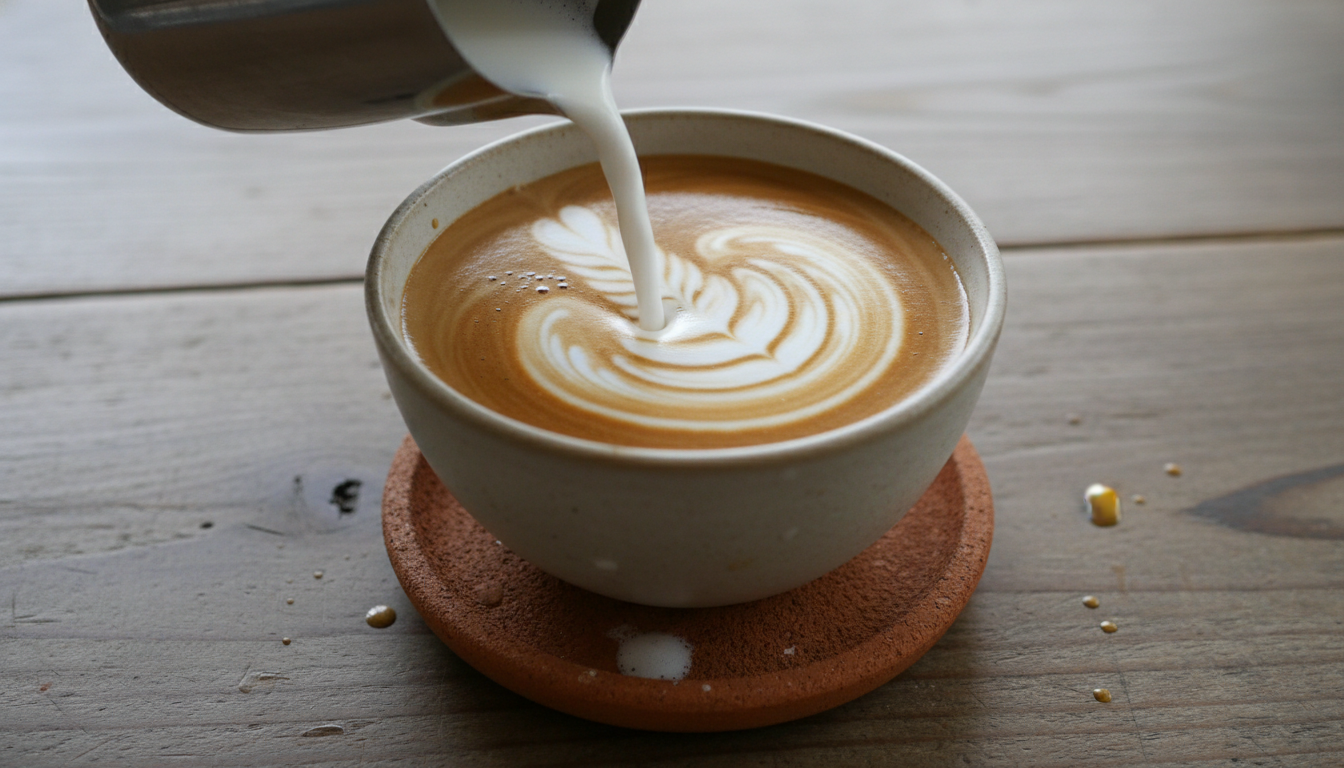
How to Texture Milk for Microfoam: The Secret to Velvet Milk
Master the technique for transforming ordinary milk into silky, glossy microfoam—the foundation of professional milk drinks and latte art
Quick Answer: Texturing Milk for Microfoam
Texturing milk requires creating a whirlpool vortex that folds air bubbles into the liquid milk, producing microscopic bubbles too small to see. Position the steam wand tip 1-2cm below the surface at a 15-30 degree angle off-center. The vortex should spin rapidly without introducing new air. Texture until 140-150°F for glossy, velvet microfoam.
Understanding Microfoam: The Science of Velvet Milk
Microfoam is milk that has been heated and aerated to create a matrix of microscopic air bubbles (less than 100 micrometers) uniformly distributed throughout the liquid. These bubbles are too small to see individually, creating the characteristic glossy, wet-paint appearance that defines professional milk texturing.
The science behind microfoam involves milk proteins—primarily casein and whey—denaturing during heating and forming films around air bubbles. These protein films stabilize the bubbles, preventing them from popping or rising to the surface. Proper texturing creates millions of tiny bubbles rather than thousands of large ones, resulting in smooth, creamy mouthfeel rather than airy foam.
Microfoam differs from "dry foam" (large bubbles, airy texture) and "steamed milk" (heated but unaerated). True microfoam maintains its structure when poured, integrating seamlessly with espresso crema rather than floating on top as separate foam. This integration is essential for latte art and premium milk drink texture.
Microfoam Characteristics
Visual Qualities
- • Glossy, reflective surface
- • Wet-paint appearance
- • No visible bubbles
- • Uniform color and texture
Physical Properties
- • Viscous, honey-like pour
- • Silky mouthfeel
- • Temperature: 140-150°F
- • Volume increase: 20-30%
Equipment for Texturing Milk
Essential Equipment
- Traditional Steam Wand: Manual control is essential for microfoam texturing. Automatic/panarello wands cannot produce true microfoam.
- Stainless Steel Pitcher: 12oz (350ml) capacity for single drinks. The steel conducts heat, helping gauge temperature by hand.
- Pointed Spout: Pitchers with sharp, pointed spouts provide control for latte art pouring after texturing.
- Fresh Cold Milk: Whole milk (3.5%+ fat) at 38-40°F provides the best protein structure for microfoam.
Steam Wand Requirements
- Steam Pressure: Minimum 1.0 bar (1.5+ bar preferred) for sufficient power to create vortex.
- Single-Hole Tip: Traditional single-hole tips offer best control. Multi-hole tips work but require adjustment.
- No Panarello: Avoid Panarello "auto-frothing" attachments—they introduce air too aggressively.
- Dry Steam: Properly purged wands deliver dry steam, not wet spray that dilutes milk.
The Microfoam Texturing Technique
Phase 1: Stretching (Air Introduction)
Before texturing begins, air must be introduced into the milk. This stretching phase occurs when the steam wand tip is positioned at the surface, creating the characteristic "tch-tch" paper-tearing sound as air enters the milk.
- Duration: 2-4 seconds for latte art milk
- Position: Steam wand tip just breaking the surface
- Sound: Gentle intermittent hissing/tearing
- Visual: Milk surface rises 20-30%
Common Mistake: Stretching too long creates excessive foam volume that cannot be fully textured into microfoam.
Phase 2: Texturing (The Vortex)
Once sufficient air is introduced, the texturing phase begins. Submerging the steam wand tip deeper while maintaining the vortex folds the air bubbles into microscopic size.
- Position: Steam wand tip 1-2cm below surface
- Angle: 15-30 degrees off-center
- Vortex: Rapid spinning whirlpool throughout pitcher
- Sound: Smooth humming (no hissing)
- Duration: Until 140-150°F reached
Step-by-Step Microfoam Texturing
Start with Cold Milk
Fill pitcher to 1/3 capacity with fresh cold milk (38-40°F). Cold milk provides more time for texturing before reaching target temperature.
Position the Steam Wand
Angle the steam wand 15-30 degrees off-center. Submerge the tip just below the surface (approximately 0.5cm) to start the stretching phase.
Stretch Briefly
Open steam fully and hold position for 2-4 seconds while listening for the gentle "tch-tch" sound. The milk surface should rise noticeably.
Submerge for Texturing
Raise the pitcher slightly (or lower the wand) to submerge the tip 1-2cm below the surface. The hissing should stop, replaced by smooth humming.
Maintain the Vortex
Hold the position steady as the milk spins rapidly. The vortex should pull surface bubbles down into the milk, folding them into microfoam. Continue until the pitcher becomes too hot to hold (140-150°F).
Polish the Microfoam
Remove from steam wand, wipe wand immediately, tap pitcher firmly once on counter to pop large bubbles, then swirl vigorously until the surface gleams like wet paint.
The Vortex: Why Spinning Matters
The whirlpool vortex created during texturing serves two critical functions. First, it distributes heat evenly throughout the milk, preventing hot spots that can scorch proteins. Second, and more importantly for microfoam, the vortex folds air bubbles down from the surface and forces them through the high-velocity spinning milk, breaking large bubbles into microscopic ones.
A strong vortex should pull bubbles from the surface down into the milk column, then circulate them back up. This continuous circulation breaks down bubble size while integrating air throughout the liquid. The result is uniform microfoam rather than separated foam and liquid layers.
Creating an effective vortex requires proper steam wand positioning. The wand should be angled off-center (never straight down the middle) so steam hits the pitcher wall and reflects back, creating rotational force. The tip should be positioned where the steam jet can push milk along the pitcher wall without breaking the surface.
Vortex Troubleshooting
- Weak or No Vortex: Wand positioned too deep or too centered. Move slightly shallower and more toward the pitcher wall.
- Splashing Milk: Wand too shallow. Submerge tip deeper below surface.
- Bubbles Not Incorporating: Vortex not strong enough. Check steam pressure and adjust angle for more rotational force.
Temperature Control for Perfect Microfoam
| Temperature | Milk State | Hand Sensation | Result |
|---|---|---|---|
| 100-120°F | Warming | Warm, comfortable to hold | Early texturing phase |
| 140-150°F | Optimal | Hot, uncomfortable but tolerable | Target microfoam range |
| 160°F+ | Overheated | Too hot to hold | Proteins denatured, flat texture |
Temperature control is critical for microfoam quality. Between 140-150°F, milk proteins denature sufficiently to stabilize air bubbles without breaking down completely. This creates the stable microfoam structure that holds together when poured.
Above 160°F, whey proteins denature irreversibly, causing them to clump and lose their foaming properties. Overheated milk produces flat, thin foam that cannot support latte art and tastes scorched or "cooked." Once overheated, milk cannot be salvaged—discard and start fresh.
Learning temperature by hand sensation takes practice. Use a thermometer initially, noting how the pitcher feels at target temperature. Eventually, the "too hot to hold comfortably" sensation becomes instinctive, allowing thermometer-free texturing.
Microfoam Problems and Solutions
Problem: Large Visible Bubbles
Cause: Steam wand positioned too high during stretching, introducing air too aggressively.
Solution: Submerge the steam wand tip slightly deeper during stretching. The sound should be gentle tearing, not loud hissing. If large bubbles appear during texturing, the vortex may be too weak—increase rotational speed by adjusting wand angle.
Problem: Foam and Liquid Separation
Cause: Insufficient texturing time or weak vortex. Large bubbles rise to surface rather than being broken down.
Solution: Extend texturing phase duration. Ensure strong vortex throughout the pitcher. After steaming, swirl more aggressively to reintegrate separated components.
Problem: Flat Milk with No Foam
Cause: Steam wand too deep throughout entire process, missing the stretching phase entirely.
Solution: Begin with steam wand at the surface for 2-4 seconds to introduce air before submerging for texturing.
Problem: Scorched or Burnt Taste
Cause: Milk overheated beyond 160°F, denaturing proteins and creating cooked flavor.
Solution: Use thermometer until temperature sensation becomes instinctive. Stop steaming when pitcher becomes uncomfortably hot. Start with cold milk to maximize texturing time before overheating.
Problem: Inconsistent Texture
Cause: Inconsistent steam wand position or movement during texturing.
Solution: Once positioned for texturing (Phase 2), hold completely steady. Any movement disrupts vortex formation. Anchor your hand or pitcher to maintain consistent position.
Microfoam Practice Exercises
Exercise 1: Water Only
Practice vortex formation using water with a drop of dish soap. The soap creates visible bubbles that show vortex strength and circulation patterns.
- • Observe bubble circulation down and around
- • Experiment with wand angles
- • No waste—practice repeatedly
Exercise 2: Temperature Drills
Steam milk to specific temperatures using a thermometer, then record hand sensations. Build the association between temperature and tactile feedback.
- • Stop at 120°F—note sensation
- • Stop at 140°F—note sensation
- • Stop at 155°F—note sensation
Exercise 3: Stretch-Only Practice
Practice only the stretching phase (2-4 seconds) then stop. Examine the foam created. Repeat until consistent bubble size is achieved.
- • Listen for consistent "tch-tch"
- • Observe volume increase
- • Aim for small, uniform bubbles
Exercise 4: Texture-Only Practice
Use milk already stretched (or simulate by shaking milk to introduce bubbles), then practice only texturing phase. Focus on vortex strength and bubble breakdown.
- • Watch bubbles disappear
- • Feel vortex strength
- • Time to glossy finish
Related Milk Texturing Guides
How to Steam Milk for Latte Art
Complete guide to the full milk steaming process from start to finish
Latte Art Pouring Guide
Learn patterns: heart, rosetta, tulip with properly textured milk
Latte Art Troubleshooting
Diagnose milk and pouring problems affecting your latte art
Milk Temperature Science
Understanding protein denaturation and optimal steaming temperatures
Frequently Asked Questions
What's the difference between microfoam and regular foam?
Microfoam consists of microscopic bubbles (under 100 micrometers) creating a silky, glossy liquid that integrates with espresso. Regular foam has visible bubbles, airy texture, and sits on top of drinks rather than integrating. Microfoam pours like paint; regular foam piles like meringue.
Why does my microfoam look good but not pour well?
Good-looking microfoam that won't pour usually indicates over-aeration (too much stretching). The foam may look glossy but have excessive air content. Reduce stretching time to 2-3 seconds and ensure thorough texturing to integrate all air bubbles.
Can you texture milk without a steam wand?
True microfoam requires steam pressure and heat that only espresso machine steam wands provide. French press methods, electric frothers, and hand frothers create foam but cannot achieve the microscopic bubble structure and glossy texture of properly textured microfoam.
Why does whole milk texture better than skim milk?
Milk fat stabilizes foam structure by surrounding air bubbles and preventing them from popping. Whole milk (3.5%+ fat) creates more stable, creamy microfoam. Skim milk can foam but produces larger bubbles and thinner, less creamy texture.
How do I texture milk for cappuccino vs latte?
Cappuccino requires more foam volume—stretch for 4-5 seconds to increase volume by 40-50%. Latte art milk requires less stretching—2-3 seconds for 20-30% volume increase. Both require the same texturing phase to create microfoam, but cappuccino foam is airier and less integrated.
The Art of Milk Texturing
Texturing milk for microfoam transforms simple dairy into a silky, glossy medium that elevates espresso drinks from ordinary to extraordinary. The technique—brief stretching followed by thorough vortex texturing—requires practice but rewards consistency.
Understanding the science behind microfoam helps troubleshoot problems. Milk proteins stabilize air bubbles; temperature affects protein structure; vortex action breaks down bubble size. Each element works together to create the velvet texture that defines premium milk drinks.
With proper equipment, cold whole milk, and dedicated practice, anyone can master milk texturing. The glossy, paint-like microfoam that emerges from the pitcher represents the perfect union of technique and science—ready to pour into beautiful latte art and deliver exceptional mouthfeel in every sip.