How to Brew Better Pour Over Coffee at Home
Master the art of manual brewing with precise techniques that extract maximum flavor clarity and complexity
Quick Answer
Better pour over coffee requires a 1:16 coffee-to-water ratio, water at 200-205°F, medium-fine grind resembling coarse sand, and controlled circular pouring in 30-second intervals. The complete brew time should reach 3-4 minutes for optimal extraction.
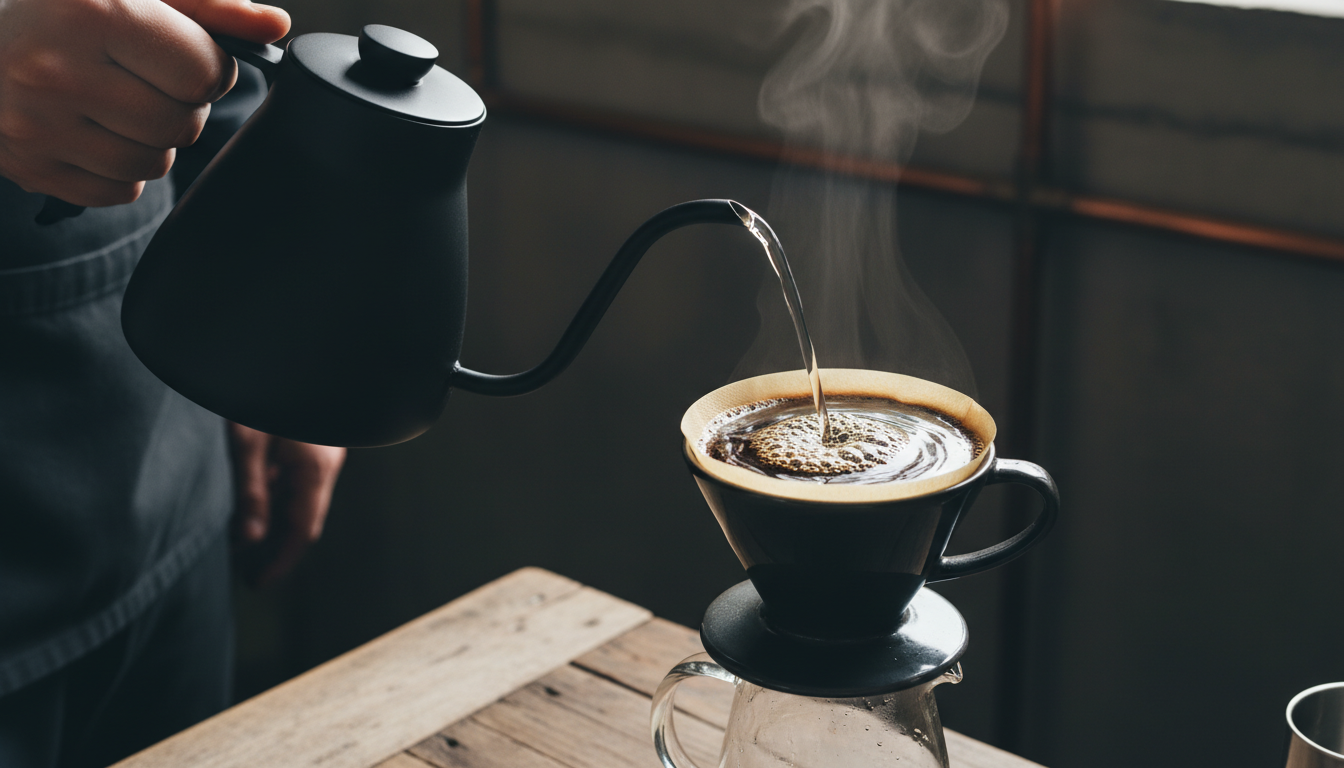
Pour Over Equipment: Essential Components
Primary Equipment Entity Definition
Pour Over Brewing System: A manual coffee extraction method where hot water passes through a bed of ground coffee contained in a filter, with flow rate controlled by grind size, pour technique, and filter geometry.
Equipment Taxonomy:
Pour Over Drippers
- ├─ Hario V60 (conical, ribbed walls, fast flow)
- ├─ Chemex (thick filter, sediment-free, shared brewing)
- ├─ Kalita Wave (flat bottom, three holes, consistent)
- └─ Melitta (single hole, beginner-friendly)
Supporting Equipment
- ├─ Gooseneck Kettle (pour control, temperature stability)
- ├─ Burr Grinder (particle consistency, extraction evenness)
- ├─ Digital Scale (dose accuracy, ratio precision)
- └─ Timer (bloom control, extraction timing)
Coffee to Water Ratio: The Foundation
The standard pour over coffee ratio is 1:16—one part coffee to sixteen parts water. This ratio produces balanced extraction with proper strength for most coffee origins and roast levels. For a single 12-ounce cup, use 22 grams of coffee to 350 grams of water.
Ratio adjustments modify strength and extraction. A 1:15 ratio (stronger) suits lighter roasts and brings out more origin character. A 1:17 ratio (weaker) works better for darker roasts and reduces bitterness. Always adjust grind size rather than ratio when troubleshooting extraction issues.
| Desired Output | Coffee Dose | Water Volume | Ratio |
|---|---|---|---|
| Single Cup (8 oz) | 15g | 240g | 1:16 |
| Large Cup (12 oz) | 22g | 350g | 1:16 |
| Two Cups (16 oz) | 30g | 480g | 1:16 |
| Chemex (32 oz) | 55g | 880g | 1:16 |
Grind Size: The Critical Variable
Pour over coffee requires a medium-fine grind—slightly coarser than espresso but finer than French press. The particles should resemble coarse sand or kosher salt in texture. This grind size allows proper extraction time while preventing over-extraction bitterness.
Grind size directly controls flow rate and extraction. Too fine grinds cause slow drainage, over-extraction, and bitterness. Too coarse grinds produce fast flow, under-extraction, and sourness. Adjust grind size by small increments (one click on most grinders) when dialing in.
Grind Size by Brewing Device
Hario V60: Medium-fine (like coarse sand) — Faster flow requires finer grind
Chemex: Medium-coarse (like sea salt) — Thick filter slows flow naturally
Kalita Wave: Medium (between sand and salt) — Flat bottom provides consistency
Water Temperature: Extraction Control
The optimal water temperature for pour over coffee ranges from 200°F to 205°F (93°C to 96°C). This temperature range extracts soluble compounds efficiently without scalding the coffee or introducing bitterness. Light roasts benefit from higher temperatures (204-205°F) to extract dense cellular structure. Dark roasts perform better at lower temperatures (200-202°F) to prevent over-extraction of carbonized compounds.
Water temperature stability matters throughout the brew. A gooseneck kettle with temperature control maintains consistent heat, while standard kettles lose 5-10 degrees during pouring. Preheating the dripper and vessel with hot water prevents temperature drop during brewing.
Step-by-Step Pour Over Technique
Step 1: Prepare Equipment and Rinse Filter
Place the pour over dripper on the brewing vessel. Insert the paper filter and rinse with hot water to remove paper taste and preheat equipment. Discard rinse water before adding coffee grounds.
Step 2: Add Coffee and Level Bed
Add ground coffee to the filter. Gently shake the dripper to level the coffee bed—an even surface promotes uniform extraction. Zero the scale to prepare for water measurement.
Step 3: The Bloom Phase (0:00-0:45)
Pour 50-60g of water (twice the coffee weight) in slow circles, starting from the center and moving outward. Allow the coffee to bloom for 45 seconds—fresh coffee will expand and release CO2. This phase prepares grounds for even extraction.
Step 4: First Pour (0:45-1:30)
Pour water in slow, controlled circles from the center outward, avoiding direct pouring on the filter walls. Add 150g of water (total 200g). Maintain a steady flow rate and keep the slurry height consistent.
Step 5: Second Pour (1:30-2:15)
When the water level drops to expose the coffee bed, pour another 150g using the same circular motion. Total water should reach 350g. Keep the kettle spout close to the coffee surface for temperature stability.
Step 6: Drawdown and Completion (2:15-3:30)
Allow all water to drain through the coffee bed. The total brew time should reach 3:00 to 3:30 for Hario V60, 3:30 to 4:30 for Chemex. Remove the dripper once the stream becomes drops. Swirl the brewed coffee and serve.
Pouring Technique: The Art of Control
Circular pouring creates even saturation across the coffee bed. Start at the center and spiral outward to the edges, then spiral back to center. Never pour directly onto the filter paper—water bypasses the coffee bed and produces weak, under-extracted coffee.
Pour height affects agitation and extraction. Keeping the kettle spout 2-4 inches above the coffee bed provides gentle agitation without disturbing the bed structure. Higher pours increase agitation and extraction but risk channeling. Lower pours provide stability but may under-extract.
Pulse pouring (multiple small pours) versus continuous pouring creates different extraction profiles. Pulse pouring provides more control and consistency for beginners. Continuous pouring, mastered by advanced baristas, can produce more even extraction with practice.
Troubleshooting Common Issues
| Problem | Cause | Solution |
|---|---|---|
| Bitter, harsh taste | Over-extraction, grind too fine | Coarsen grind by 2-3 clicks, reduce brew time |
| Sour, weak taste | Under-extraction, grind too coarse | Fine grind by 2-3 clicks, extend brew time |
| Fast drain (under 2:30) | Grind too coarse, channeling | Fine grind, improve pour technique |
| Slow drain (over 4:30) | Grind too fine, fines migration | Coarsen grind, use better grinder |
| Uneven extraction | Poor pour technique, unlevel bed | Practice circular pours, level coffee bed |
Related Brewing Guides
Hario V60 Pour Over Guide
Master the iconic conical dripper with device-specific techniques and recipes.
Chemex Brewing Complete Guide
Learn the thick-filter method for clean, sediment-free coffee.
Best Gooseneck Kettle for Coffee
Find the perfect pour-over kettle with temperature control and flow precision.
Coffee Grind Size Guide
Understand particle size and its impact on every brewing method.
AeroPress vs Espresso Machine
Compare manual brewing methods and their flavor profiles.
Best Coffee Grinder Under $100
Affordable burr grinders that deliver consistent pour-over results.
Frequently Asked Questions
Can I use pre-ground coffee for pour over?
Pre-ground coffee works but produces suboptimal results. Coffee begins losing aromatic compounds within minutes of grinding. For best results, grind immediately before brewing with a burr grinder set to medium-fine.
Why is my pour over coffee weak?
Weak pour over coffee usually results from a grind too coarse, water too cool, or improper ratio. Verify the coffee-to-water ratio (1:16), check water temperature (200-205°F), and ensure the grind resembles coarse sand.
Do I need a gooseneck kettle?
A gooseneck kettle significantly improves pour control and consistency. The narrow spout allows precise water placement and flow rate control. While standard kettles work, gooseneck kettles elevate pour over quality.
How fresh should coffee beans be?
Use coffee beans between 7-21 days post-roast for pour over. Beans too fresh produce excessive bloom and uneven extraction. Beans too old lack aromatic complexity. Store beans in airtight containers away from light.
Conclusion: Mastering Pour Over Coffee
Better pour over coffee requires understanding the relationship between grind size, water temperature, and pouring technique. Start with the 1:16 ratio and medium-fine grind as baseline parameters. Adjust one variable at a time when dialing in to isolate cause and effect.
Practice the bloom phase and circular pouring motion until the technique becomes muscle memory. Time the brew and taste the results—brew time indicates extraction efficiency, while taste reveals extraction quality. A well-executed pour over delivers clarity, complexity, and origin character unmatched by automatic methods.
Invest in quality equipment within the budget: a burr grinder provides the biggest improvement, followed by a gooseneck kettle and digital scale. With proper technique and fresh coffee, home pour over rivals cafe quality at a fraction of the cost.