Flat Burr vs Conical Burr Grinder: Taste Difference Explained
Why burr geometry fundamentally changes how espresso tastes—and which burr type matches your flavor preferences
Quick Answer
Flat burr grinders produce higher grind uniformity and emphasize clarity, brightness, and distinct flavor separation in espresso. Conical burr grinders generate a slightly broader particle distribution that creates fuller body, richer mouthfeel, and more blended flavor complexity. Neither burr geometry is objectively superior—flat burrs favor precision, conical burrs favor texture.
How Flat Burr and Conical Burr Geometry Affect Coffee Grinding
Flat burr grinders use two parallel, horizontally-aligned cutting discs that force coffee beans outward through progressively narrower channels. Flat burr geometry creates a unimodal particle distribution—meaning most coffee particles land within a narrow size range. This unimodal distribution from flat burr grinders produces even extraction across all coffee particles simultaneously, resulting in flavor clarity and distinct tasting notes.
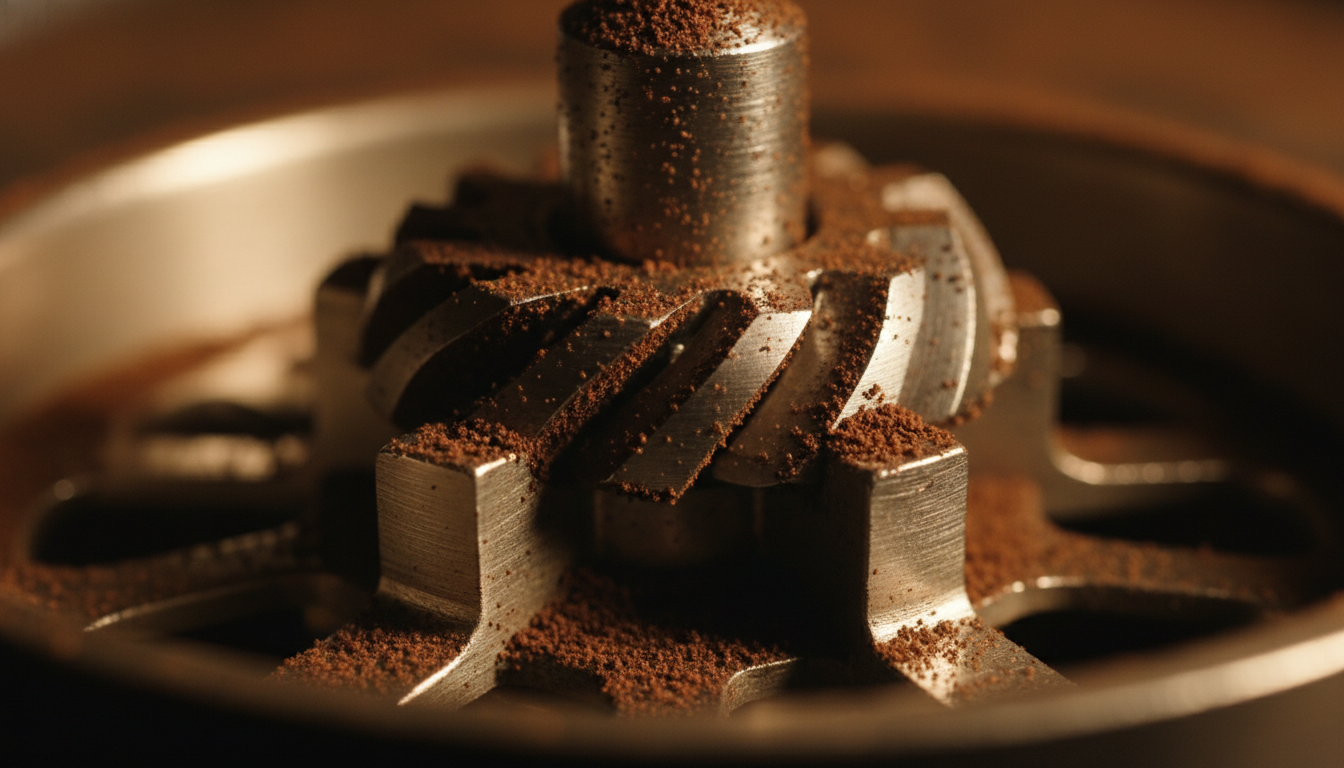
Conical burr grinders use a cone-shaped inner burr sitting inside a ring-shaped outer burr. Conical burr geometry pulls coffee downward through gravity-assisted channels, creating a bimodal particle distribution—two peaks of particle sizes rather than one. The bimodal distribution from conical burr grinders means some particles extract faster and some slower, blending multiple extraction stages into fuller body and more integrated flavor profiles.
| Characteristic | Flat Burr Grinder | Conical Burr Grinder |
|---|---|---|
| Particle Distribution | Unimodal (narrow range) | Bimodal (two peaks) |
| Flavor Profile | Clarity, brightness, distinct notes | Body, richness, blended complexity |
| Acidity Expression | Higher perceived acidity | Rounded, integrated acidity |
| Body | Medium, tea-like | Full, syrupy |
| Heat Generation | Higher (higher RPM needed) | Lower (gravity-assisted) |
| Retention | Higher (horizontal channels) | Lower (gravity-fed exit) |
| Noise Level | Louder | Quieter |
Flat Burr vs Conical Burr Espresso Taste Differences
Flat burr espresso tends to showcase individual flavor notes with separation and definition. When brewing a single-origin Ethiopian coffee through a flat burr grinder, drinkers typically identify distinct blueberry, jasmine, and citrus notes individually. The same Ethiopian coffee ground through a conical burr grinder tends to blend those notes into a unified fruity-floral experience with heavier body. According to research published by the Specialty Coffee Association, grind uniformity accounts for up to 30% of perceived flavor differences in espresso extraction.
Conical burr grinders excel at producing traditional espresso profiles—the rich, chocolatey, full-bodied shots that define Italian espresso culture. Conical burr geometry naturally creates the texture and mouthfeel associated with classic espresso. Flat burr grinders excel at modern specialty espresso—the bright, fruity, complex shots that third-wave coffee culture celebrates. Flat burr geometry highlights origin characteristics and processing method nuances.
The Specialty Coffee Association's sensory analysis protocols confirm that grind particle distribution directly correlates with perceived body and acidity. Unimodal distributions from flat burr grinders score higher on acidity and flavor clarity metrics. Bimodal distributions from conical burr grinders score higher on body and aftertaste metrics. Neither distribution pattern produces objectively better espresso—the preference depends entirely on the drinker's flavor priorities.
Choosing Between Flat Burr and Conical Burr Grinders for Home Espresso
Choose a Flat Burr Grinder When:
- • Brewing light-roast single-origin espresso
- • Prioritizing flavor clarity over body
- • Exploring specialty coffee from different origins
- • Wanting pour-over-like transparency in espresso
- • Budget allows $300+ for quality flat burr sets
Choose a Conical Burr Grinder When:
- • Brewing medium-to-dark roast espresso blends
- • Prioritizing body and mouthfeel over clarity
- • Making milk-based espresso drinks regularly
- • Wanting lower noise and lower retention
- • Budget ranges from $100-$500 for versatile grinding
For milk-based espresso drinks like lattes and cappuccinos, conical burr grinders often perform better because the fuller body from conical burr grinding cuts through milk more effectively. Flat burr espresso flavors can become muted when mixed with steamed milk. For straight espresso or americanos, flat burr grinders highlight the nuances that make each coffee unique. Many advanced home baristas own both a flat burr and conical burr grinder to match burr geometry with bean and drink selection.
Popular Flat Burr and Conical Burr Grinders Compared
| Grinder Model | Burr Type | Burr Size | Taste Character | Price Range |
|---|---|---|---|---|
| Eureka Mignon Specialita | Flat | 55mm | Clean, bright, defined | $400-$500 |
| Niche Zero | Conical | 63mm | Rich, full-bodied, sweet | $250-$350 |
| DF64 | Flat | 64mm | Clarity, precision, upgradeable | $300-$400 |
| Baratza Sette 270 | Conical | 40mm | Balanced, versatile | $350-$400 |
| Mazzer Mini | Flat | 64mm | Commercial clarity, dense | $500-$700 |
Research & Authoritative Sources on Burr Grinder Taste
Grind uniformity contribution to perceived flavor differences
Source: Specialty Coffee Association Research
Ideal espresso extraction yield regardless of burr type
Source: SCA Golden Cup Standards
Specialty Coffee Association - Grind Quality Research
Visit Source →Journal of Food Engineering - Coffee Particle Analysis
Visit Source →Barista Hustle - Grind Distribution Studies
Visit Source →Related Grinder Guides & Comparisons
Conical vs Flat Burr Grinder Comparison
Full side-by-side comparison of conical burr and flat burr grinder features, pricing, and performance.
Are Bigger Flat Burrs Better for Espresso?
How flat burr size affects grind quality, heat generation, and espresso extraction consistency.
Best 64mm Flat Burr Grinder for Espresso
Top-rated 64mm flat burr grinders evaluated for espresso quality and value.
Eureka Specialita vs Niche Zero Comparison
Flat burr Eureka Specialita versus conical burr Niche Zero—the ultimate grinder showdown.
Beginner Coffee Grinder Guide
Complete guide to choosing your first coffee grinder for espresso and filter brewing.
Are Flat Burrs Good for Espresso?
Evaluating flat burr grinder performance specifically for espresso extraction quality.
Frequently Asked Questions About Flat Burr vs Conical Burr Taste
Can most people taste the difference between flat burr and conical burr espresso?
Experienced espresso drinkers can reliably identify flat burr espresso from conical burr espresso in blind evaluations. Beginners may notice body and texture differences before identifying specific flavor note separation. The difference becomes more pronounced with light-roast specialty coffees than with dark-roast blends.
Which burr type produces better crema on espresso?
Conical burr grinders tend to produce slightly thicker crema due to the bimodal grind distribution creating more CO2 release variability during extraction. Flat burr grinders produce thinner but more persistent crema. Crema thickness alone does not indicate espresso quality—flavor and balance matter more.
Do flat burr grinders require more maintenance than conical burr grinders?
Flat burr grinders accumulate more grounds in horizontal channels, requiring more frequent cleaning. Conical burr grinders benefit from gravity-assisted clearing, reducing retention and maintenance frequency. Both flat burr and conical burr sets require replacement after grinding approximately 500-1,000 kg of coffee.