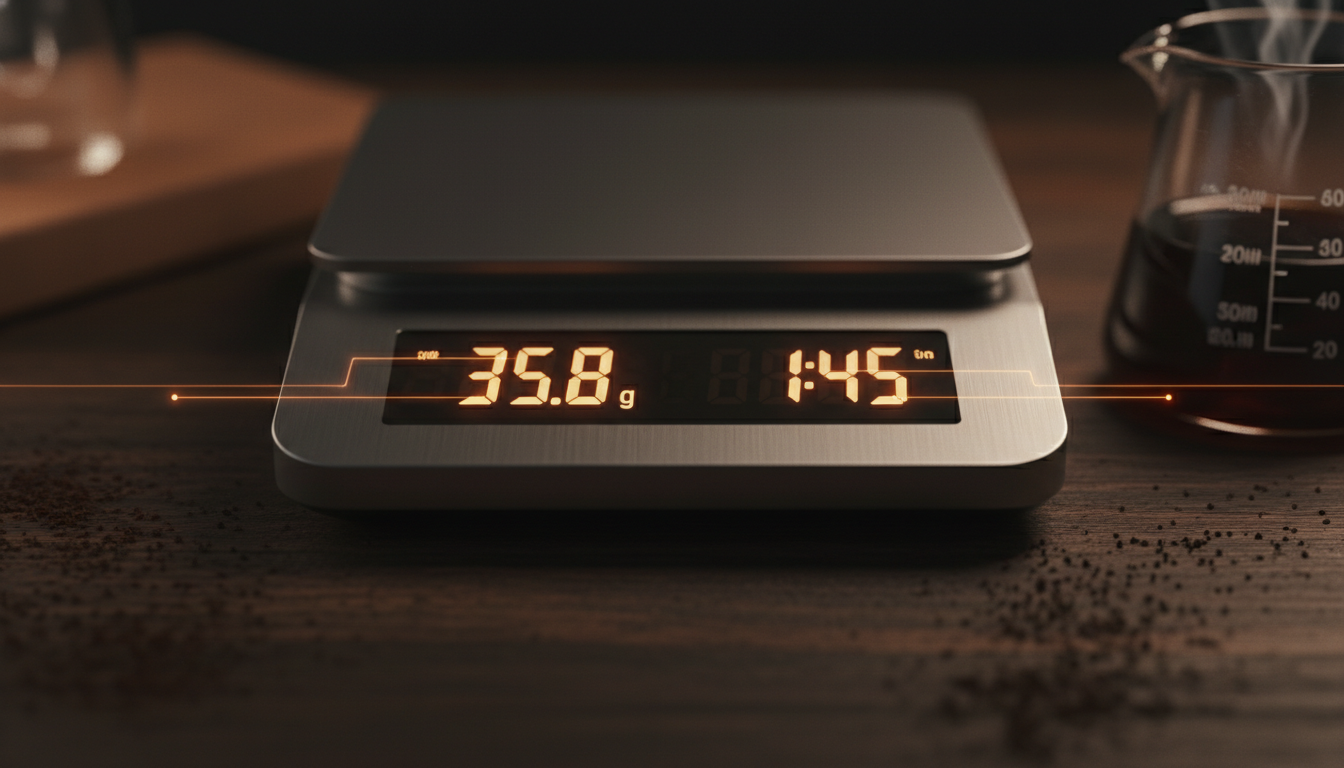
SCA Coffee Ratio Quick Answer
A common SCA-style coffee ratio baseline is 1:16 to 1:18 (coffee grams : water grams). A practical starting point for many brewers is 1:17, which equals 60 g of coffee per 1,000 g of water. Coffee ratio changes affect brew strength first and extraction second, so ratio work should pair with grind size and brew time control.
Coffee ratio describes the relationship between coffee dose and brew water mass. Coffee ratio is the simplest brewing variable to standardize because coffee ratio uses grams rather than volume measurements. Coffee ratio standardization improves repeatability across pour over brewing, drip coffee brewing, and immersion brewing.
SCA coffee ratio discussions often connect to the SCA brewing control chart, which links brew strength (TDS) and extraction yield. Coffee ratio is a major contributor to beverage strength, but coffee ratio does not guarantee balanced extraction without grind size control and contact-time control.
Coffee-to-Water Ratio Basics
What Coffee Ratio Means
A coffee ratio expresses coffee mass compared to water mass, like 1:16 or 1:17. A 1:16 coffee ratio means 1 gram of coffee for every 16 grams of water. Coffee ratio math stays consistent across batch sizes, which allows easy scaling from a single mug to a full carafe.
Why Coffee Ratio Uses Grams
Coffee volume measurements change with grind size and roast level because coffee density varies. Water volume measurements change with temperature and measuring technique. Coffee ratio grams eliminate density variability and reduce measurement error, especially when a digital scale is used.
Practical SCA-Style Coffee Ratio Targets
1:16 Coffee Ratio (Stronger)
A 1:16 coffee ratio often produces a stronger cup with heavier body. A 1:16 coffee ratio can help milk-based drip drinks and can help darker roasts that taste thin at weaker ratios. A 1:16 ratio can also amplify bitterness when grind is too fine.
1:17 Coffee Ratio (Balanced Baseline)
A 1:17 coffee ratio is a widely used starting point for pour over brewers and drip brewers. A 1:17 coffee ratio often produces balanced strength for medium roasts. A 1:17 ratio also makes scaling easy because 60 g per 1,000 g water is a clean conversion.
1:18 Coffee Ratio (Lighter)
A 1:18 coffee ratio often produces a lighter cup with higher perceived clarity. A 1:18 coffee ratio can highlight washed single origin coffees and delicate aromatics. A 1:18 ratio can taste weak if grind size is too coarse or if brew time is too short.
Coffee Ratio Examples (Common Batch Sizes)
| Water | 1:16 Coffee | 1:17 Coffee | 1:18 Coffee |
|---|---|---|---|
| 250 g | 15.6 g | 14.7 g | 13.9 g |
| 350 g | 21.9 g | 20.6 g | 19.4 g |
| 500 g | 31.3 g | 29.4 g | 27.8 g |
| 1,000 g | 62.5 g | 58.8 g | 55.6 g |
How Coffee Ratio Interacts with Grind and Extraction
Coffee Ratio Changes Brew Strength Directly
A stronger coffee ratio (more coffee per water) increases beverage strength because dissolved solids concentration rises. A weaker coffee ratio (less coffee per water) decreases beverage strength because dissolved solids concentration falls. Brew strength changes can occur without changing grind size or brew time.
Coffee Ratio and Extraction Yield Are Connected but Not Equivalent
Extraction yield measures how much soluble material leaves the coffee grounds and ends in the beverage. Coffee ratio influences contact dynamics and flow, but grind size and brew time usually drive extraction yield more directly. Coffee ratio work should be paired with an extraction-focused approach.
Frequently Asked Questions About SCA Coffee Ratios
Is 1:17 the best coffee ratio?
A 1:17 coffee ratio is a reliable baseline, but a best ratio depends on roast level, brewing method, and taste target. Many brewers adjust between 1:16 and 1:18 to align strength with preference.
How does coffee ratio change for immersion brewing?
Immersion brewing methods often use ratios in the same general range, but immersion brewing can tolerate small ratio shifts because extraction is less flow-dependent. AeroPress recipes frequently vary widely because AeroPress brewing supports dilution and bypass brewing.
Should coffee ratio change when coffee tastes sour or bitter?
Sour coffee often indicates under-extraction, which usually responds better to grind size changes and brew time changes than ratio changes. Bitter coffee often indicates over-extraction, which also responds better to grind size and brew time adjustments. Ratio changes are best used to tune strength after extraction balance improves.
Related Resources
Pour Over Coffee Maker Guide
Choose a pour over method and learn pour over workflow basics
Drip Coffee Maker Guide
Learn drip coffee workflow and batch sizing considerations
AeroPress Guide
Explore immersion brewing and AeroPress recipe frameworks
Bean Selection Guide
Match coffee beans to brewing methods and flavor targets
Extraction Science Guide
Connect ratio choices to extraction yield and brew strength concepts
Pour Over Coffee History
Learn how manual brewing methods evolved in specialty coffee culture