Why Grind Consistency Matters
Coffee extraction is a chemical process where water dissolves flavor compounds from ground coffee. The size of each particle determines how quickly it extracts - smaller particles extract faster, larger ones slower.
The Extraction Problem
When your grind has mixed particle sizes (like blade grinders produce), you get simultaneous under-extraction AND over-extraction:
- • Fine particles (dust): Over-extract quickly → bitter, harsh flavors
- • Large particles (boulders): Under-extract → sour, weak, grassy notes
- • Result: Muddy, confused flavor that's both bitter AND sour
The Burr Grinder Solution
Burr grinders produce uniform particle sizes. When all particles are the same size, they extract at the same rate, giving you clean, balanced flavor with distinct tasting notes. This is why dialing in espresso is possible with burr grinders but impossible with blade grinders.
Side-by-Side Comparison
| Feature | Burr Grinder | Blade Grinder |
|---|---|---|
| Grind Consistency | Excellent - uniform particle size | Poor - mixed sizes from dust to boulders |
| Heat Generation | Low - preserves flavor | High - can burn coffee oils |
| Adjustability | Precise grind settings | None - time-based only |
| Espresso Capable | Yes (quality models) | No - impossible to achieve |
| Price Range | $50-2,000+ | $15-50 |
| Longevity | 5-15+ years | 1-3 years |
| Noise Level | Moderate to low | High - loud whirring |
| Cleanup | Moderate - requires brush | Easy - simple wipe |
How Burr Grinders Work
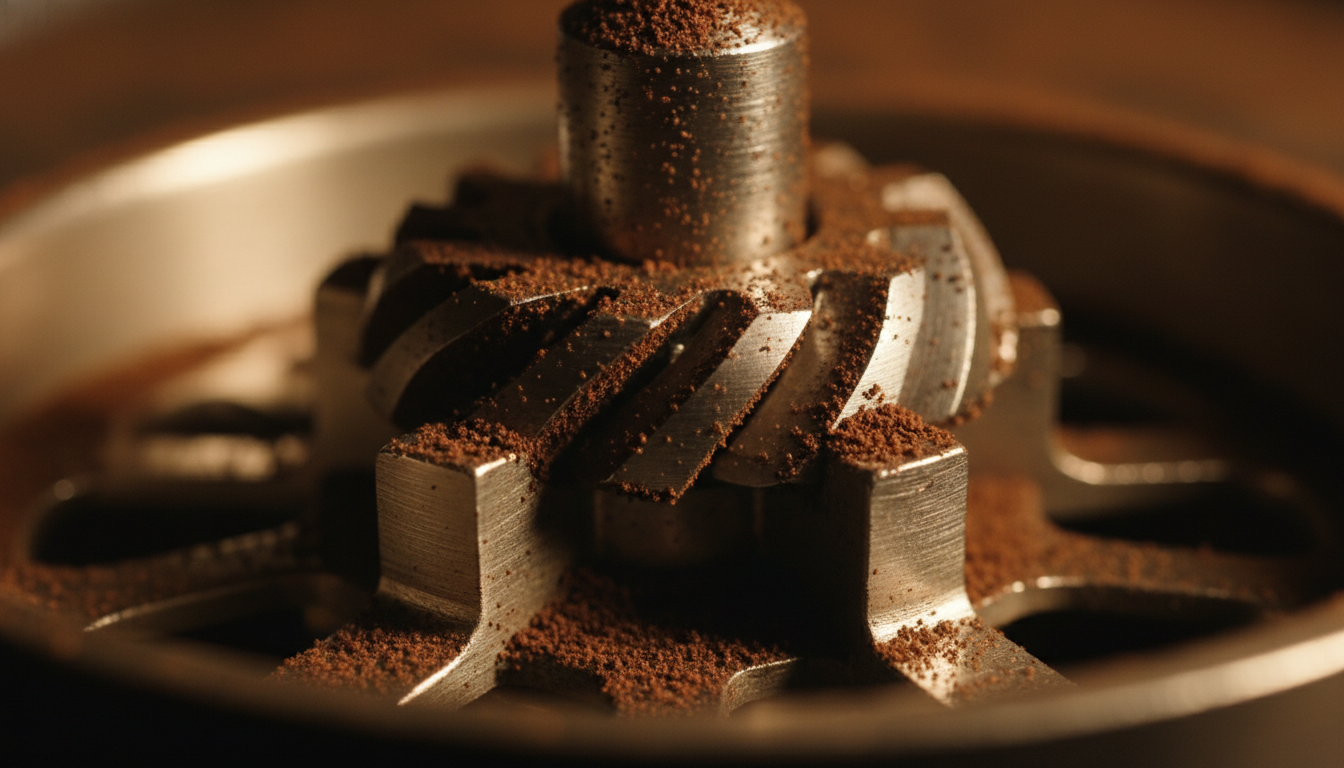
Burr grinders use two abrasive surfaces (burrs) with a precise gap between them. Beans fall through this gap and are cut into uniform pieces. The gap size determines the grind size - smaller gap equals finer grind.
Precise Gap Control
Adjustable settings let you dial in exact grind sizes for any brewing method
Consistent Cutting
Every bean is cut the same way, producing uniform particle distribution
Low Heat
Slower RPM generates less heat, preserving volatile flavor compounds
Flat vs Conical Burrs
There are two main burr designs, each with distinct characteristics. Both produce excellent results - the choice depends on your priorities.
Flat Burrs
Two parallel discs that grind beans between them. Produce uniform particles with clean, bright flavors.
Advantages:
- ✓ Most consistent grind
- ✓ Best for espresso
- ✓ Clean flavor profile
- ✓ Precise adjustments
Disadvantages:
- ✗ Higher retention
- ✗ Generate more heat
- ✗ More expensive
- ✗ Louder operation
Conical Burrs
Cone-shaped burr inside a ring burr. Beans fall through naturally with gravity assistance.
Advantages:
- ✓ Lower retention
- ✓ Less heat generation
- ✓ Quieter operation
- ✓ More forgiving
Disadvantages:
- ✗ Slightly less consistent
- ✗ Can produce more fines
- ✗ Bimodal distribution
Why Blade Grinders Fail
Blade grinders work like blenders - a spinning blade randomly chops beans into pieces. There's no control over particle size, and the result is a mix of dust, boulders, and everything in between.
Fundamental Problems
- • No grind size control: You can only control time, not particle size
- • Inconsistent results: Each grind session produces different particle distributions
- • Heat damage: High-speed spinning generates heat that damages coffee oils
- • Impossible for espresso: Cannot achieve the fine, consistent grind espresso requires
- • Static buildup: Creates messy, clingy grounds that stick everywhere
When Blade Grinders Are Acceptable
If you only use an automatic drip coffee maker and aren't particular about flavor, a blade grinder will work. The paper filter removes some inconsistencies, and drip brewing is more forgiving than other methods. However, even casual coffee drinkers notice improved flavor when switching to a quality burr grinder.
Our Top Recommendations
Based on extensive research and community feedback, here are the best burr grinders at each price point. All recommendations prioritize consistency, durability, and value.
The gold standard entry-level burr grinder. Consistent enough for pour-over and drip, marginally acceptable for espresso with pressurized baskets.
Limitations: Not ideal for unpressurized espresso baskets. Limited fine adjustment range.
Significant step up in consistency. Digital timer for dosing consistency. Better for espresso than Encore.
Limitations: Still entry-level for serious espresso. Better grinders available at this price for espresso-only use.
Purpose-built for espresso with stepless adjustment. Low retention, quiet operation. Excellent consistency.
Limitations: Single-dosing requires workflow adjustment. Not ideal for switching between brew methods.
Revolutionary single-dose design. Near-zero retention. Excellent for espresso and all brew methods. Quiet operation.
Limitations: Long wait times for orders. Premium price. Conical burrs may not suit all preferences.
Grinder Requirements by Brewing Method
| Brewing Method | Grind Size | Blade OK? | Min. Budget |
|---|---|---|---|
| Espresso | Very Fine | No - Impossible | $300+ |
| Pour Over | Medium-Fine | Barely - Poor results | $100+ |
| Aeropress | Medium | Marginal | $80+ |
| Drip Coffee | Medium | Acceptable | $50+ |
| French Press | Coarse | Barely - Fines cause sludge | $80+ |
| Cold Brew | Very Coarse | OK - Long steep time forgives | $50+ |
Is the Investment Worth It?
The Math
Coffee Waste Reduction
- • Blade grinder: ~30% of coffee under/over extracts (wasted potential)
- • Burr grinder: Nearly 100% proper extraction
- • At $15/lb for beans, saving 30% = $4.50/lb saved
- • Using 1lb/week = $234/year in better extraction
Equipment Longevity
- • Entry burr grinder: 5-10 year lifespan
- • Quality burr grinder: 10-20+ years
- • Blade grinder: 1-3 years before motor burns out
- • Long-term: Burr grinder costs less per year
The Verdict
A quality burr grinder is the single best investment you can make for your coffee setup. The grinder matters more than your espresso machine. A $500 grinder with a $300 machine will produce better espresso than a $300 grinder with a $500 machine. If budget is tight, invest in the grinder first. See our grinder recommendations and budget planning guide to get started.