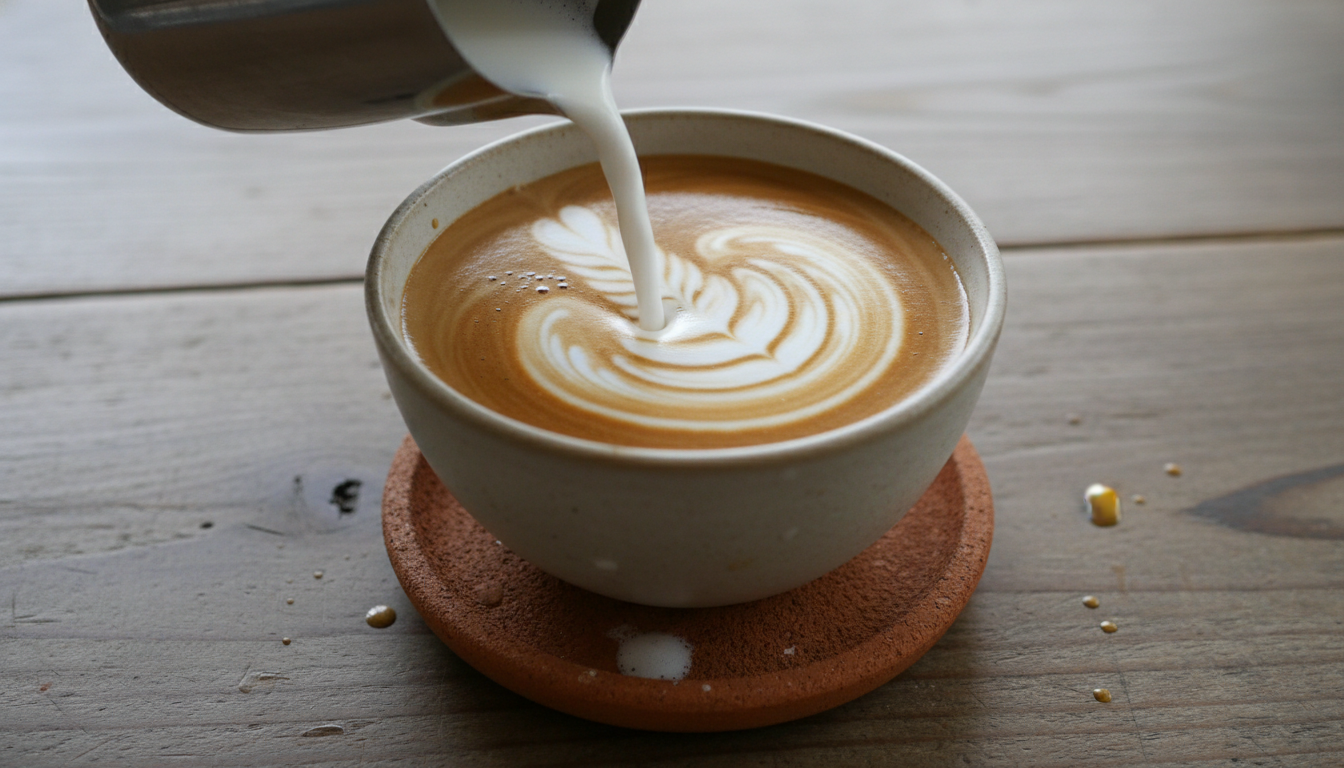
Buying Guide
Best Oat Milk for Latte Art
Complete comparison of oat milk brands specifically for latte art performance.
⏱ 10 MIN READ
READ Buying Guide →
Barista techniques, brand recommendations, and pour tips for creating stunning latte art with oat milk in 2026.
Min Protein
Sweet Spot
Aeration Time
Top Rating
Best Overall:
Oatly Barista Edition
3g protein, 3g fat, industry standard
Second Best:
Minor Figures
2.8g protein, competition-grade foam
Key insight: For latte art success, your oat milk needs minimum 2.5g protein per 100ml. Temperature control between 55-60°C (130-140°F) is critical—oat milk breaks down rapidly above 65°C.
Protein is the foundation of stable foam. When heated and aerated, oat proteins (primarily avenin) denature and create the film structure that stabilizes foam bubbles. Without adequate protein, your foam will collapse within seconds of pouring.
2.5g per 100ml is the threshold for reliable latte art. Below this, you'll struggle to create patterns that hold their shape. The sweet spot is 2.8-3g per 100ml, which is why Oatly Barista Edition and Minor Figures perform so well.
✓ Protein Content by Brand:
These barista-formulated oat milks are specifically designed for steaming and latte art. Regular oat milk lacks the fat and stabilizers needed for professional results.
Protein: 3g per 100ml
Fat: 3g per 100ml
Frothing: 9.5/10
Latte Art Performance:
Excellent — Silky, stable, holds patterns 5+ minutes
Availability:
Widely available
Pros:
Cons:
Best for: Professional latte art, rosettas, tulips, hearts
Protein: 2.8g per 100ml
Fat: 2.8g per 100ml
Frothing: 9/10
Latte Art Performance:
Excellent — Dense, very smooth, competition-grade
Availability:
Specialty stores, online
Pros:
Cons:
Best for: Competition latte art, specialty coffee shops, complex designs
Protein: 1.5g per 100ml
Fat: 3g per 100ml
Frothing: 8/10
Latte Art Performance:
Good — Smooth, moderately stable
Availability:
Widely available
Pros:
Cons:
Best for: Beginners, basic latte art, everyday use
Protein: 2g per 100ml
Fat: 3.5g per 100ml
Frothing: 8.5/10
Latte Art Performance:
Very Good — Smooth, stable, good definition
Availability:
Food service, some retail
Pros:
Cons:
Best for: Cafe use, rosetta patterns, daily latte art
Below 55°C
Too cool. Foam won't set properly. Milk tastes flat.
55-60°C
PERFECT. Optimal foam stability and sweetness.
Above 65°C
Proteins break down. Foam collapses. Watery texture.
Pro tip: Invest in a milk thermometer while learning. Once you can consistently hit 55-60°C, you'll develop a feel for the correct temperature by hand. The pitcher should be hot to touch but not uncomfortable to hold for 2-3 seconds.
Oat milk behaves differently than dairy under steam. Understanding these differences is key to achieving café-quality results at home.
| Factor | Oat Milk | Dairy Milk |
|---|---|---|
| Aeration Time | 3-5 seconds (less) | 5-8 seconds |
| Max Temperature | 55-60°C (130-140°F) | 65-68°C (150-155°F) |
| Expansion Volume | 40-50% more than dairy | ~30% expansion |
| Foam Stability | 3-5 minutes | 10+ minutes |
| Integration (Swirling) | Needs more vigorous swirling | Easier to integrate |
| Freshness Window | Use within 5-7 days of opening | More forgiving |
Start with oat milk at 36-40°F (2-4°C). Cold milk provides more time to develop microfoam before reaching the critical 150°F (65°C) threshold where oat milk proteins begin to denature and foam structure degrades.
Science: Lower starting temperature extends the steaming window, allowing better incorporation of air and smaller bubble formation.
Position steam wand tip just below the surface (1-2mm). Introduce air for 3-5 seconds by maintaining the hissing sound. Oat milk requires 15-20% less stretching than dairy milk due to higher natural expansion rates.
Science: Oat milk contains stabilizers that create larger volume expansion with less air incorporation. Over-aeration creates unstable, large bubbles.
Submerge wand deeper to create a whirlpool/vortex motion. Continue until pitcher reaches 140-150°F (60-65°C). This distributes microbubbles evenly throughout the liquid.
Science: The vortex breaks large bubbles into microfoam and evenly distributes proteins and fats that stabilize the foam structure.
Never exceed 150°F (65°C). Oat milk proteins are more heat-sensitive than dairy proteins and will break down rapidly above this temperature, resulting in thin, watery texture.
Science: Oat proteins (avenins) denature at lower temperatures than dairy caseins and whey proteins, causing foam collapse.
Tap pitcher firmly on counter 2-3 times to break surface bubbles. Swirl vigorously to integrate foam with liquid until glossy, paint-like consistency is achieved.
Science: Tapping releases trapped air; swirling homogenizes the foam structure for consistent pouring viscosity.
Oat milk has a slightly different texture than dairy, requiring adjustments to your pouring technique for the best latte art results.
Begin pouring from 1-2 inches (2.5-5cm) above the cup surface, closer than you would with dairy milk. Oat milk microfoam is slightly less dense and benefits from a shorter drop.
Why: Prevents excessive aeration and maintains foam structure integrity.
Pour slightly faster than with dairy milk. Oat milk foam sets more quickly, so you need to create your pattern before the surface begins to set.
Why: Oat milk proteins create a firmer surface faster than dairy. Adjust speed to work with this characteristic.
Use smaller, more controlled side-to-side movements for rosettas. Oat milk responds more dramatically to pitcher movement than dairy.
Why: The lighter density of oat milk microfoam means less aggressive movements create the same pattern definition.
Pour immediately after swirling the pitcher. Oat milk foam separates faster than dairy, so don't let it sit.
Why: Oat milk foam has less structural longevity. Quick pouring maintains optimal foam-to-liquid ratio.
Cause: Milk overheated above 60°C (140°F) or stretched too much
Solution: Use a thermometer and stop at 55-60°C. Reduce aeration time by 2-3 seconds.
Cause: Milk too thin (under-stretched) or poured too slowly
Solution: Increase stretching time slightly. Pour more decisively and quickly.
Cause: Poor integration - not enough tapping or swirling
Solution: Tap pitcher 4-5 times on counter. Swirl until surface is glossy like wet paint.
Cause: Oat milk brand with insufficient protein (<2.5g/100ml)
Solution: Switch to Oatly Barista Edition or Minor Figures with higher protein content.
Cause: Foam too thick or pitcher position too high
Solution: Lower pitcher closer to surface. Ensure milk has paint-like consistency before pouring.
Master these three fundamental patterns with oat milk-specific techniques. Each requires slight adjustments compared to dairy milk.
💡 Oat Milk Specific Tip:
Pour from slightly lower than dairy milk. When cup is 2/3 full, bring pitcher close to surface and pour a steady stream while moving pitcher toward you. Oat milk hearts set quickly, so commit to the motion.
⚠️ Common Mistake:
Pouring too slowly, causing the heart to stretch vertically instead of forming a round shape.
💡 Oat Milk Specific Tip:
Use gentler wrist movements than with dairy. Start the wiggle motion earlier in the pour. Oat milk rosettas benefit from a slightly faster overall pour speed to prevent the leaves from looking 'stretched'.
⚠️ Common Mistake:
Over-wiggling the pitcher. Oat milk requires about 30% less movement amplitude than dairy for the same effect.
💡 Oat Milk Specific Tip:
Stack each 'bulb' quickly. Oat milk layers set faster, so minimize time between bulb pours. Use slightly more foam in each stack than you would with dairy milk.
⚠️ Common Mistake:
Waiting too long between layers, causing separation and poor definition in the tulip stack.
Practice tip: Start with the heart pattern until you can consistently create clean, symmetrical shapes. Only move to rosetta once hearts are reliable. The tulip requires precise timing with oat milk—practice the motion without milk first using water to build muscle memory.
Stop at 55-60°C. Use a thermometer until you can gauge by touch. The pitcher should be hot but not burning to hold.
Only use "Barista Edition" formulations. Regular oat milk lacks the protein, fat, and stabilizers needed for latte art.
Use within 5-7 days of opening. Shake carton vigorously before each use. Older oat milk loses stabilizer effectiveness.
Tap and swirl more vigorously than with dairy. Oat milk needs extra encouragement to achieve that paint-like consistency.
Complete comparison of oat milk brands specifically for latte art performance.
Master milk steaming and pour beautiful latte art at home with dairy and alternatives.
Complete guide to oat milk frothing techniques and brand comparisons.
Learn professional milk steaming techniques for all milk types.
With the right oat milk brand, proper temperature control, and these technique adjustments, you can create stunning latte art that rivals any café. Start with Oatly Barista Edition or Minor Figures and practice your heart patterns first.
Explore Latte Art Fundamentals